
 In the lead up to March Madness, I wrote about determining which teams are the “most deserving” as opposed to which teams were the “best”. I eventually created what I called the Achievement S-Curve (in college basketball, the S-Curve refers to ranking and seeding teams for the tournament), essentially a rating of teams based on what they accomplished on the court.
With the initial BCS rankings released this week, I’d like to do something similar for college football. However, before revealing my rankings, I’ll first go through and discuss each of the six computer rankings in use by the BCS. I’ll point out what they do well and critique what they don’t. Following that, I’ll unveil my own Achievement Rankings. In addition, I’ll look at some other interesting aspects of the BCS system along the way: What’s the best way to make the title game? Who are this year’s best contenders? And, of course, would a playoff system be a better alternative to crowning a national champion?
If you have anything you’d be interested in seeing, post in the comments and I’ll see if I can add it in to the list. First up: a review of Jeff Sagarin’s rankings.
 Unless you’ve been living under a rock, you’ve heard that the NFL moved the kickoff line forward 5 yards to the 35 yard line. The hope is that this will result in more touchbacks and, therefore, fewer injuries due to fewer returns.
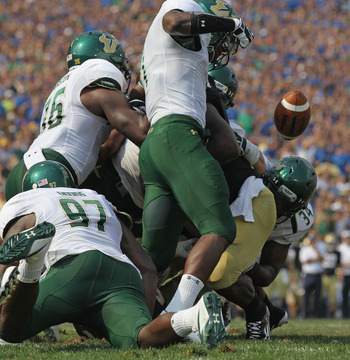 Our first big day of football is under our belt, and one of the storylines from yesterday was turnovers, specifically fumbles. Oregon lost 3 fumbles in their loss to #4 Georgia. Two of Notre Dame’s 5 turnovers were lost fumbles, including a backbreaking fumble on 3rd and 1 from the USF 1 yard line that was returned the length of the field for a TD. I
  4th and 2. Up 6. 2:08 remaining. Ball on your own 28. As a head coach, what do you do? More importantly, what process do you go through in order to make a decision.
 Earlier today, ESPN released (some) details of their brand new rating system for quarterbacks dubbed
  *UPDATE: Dan in the comments correctly points out that the numbers I listed are actually double what they should be. All the attempt numbers should be cut in half. Thanks, Dan.*
 In my last post, I discussed evaluating teams based on what they accomplished (“most deserving”) versus what they are capable of (“best”). I argued that in selecting teams for the NCAA Tournament, only a team’s wins and losses–not their margin of victory, their statistics, or their “look”–should be considered against their schedule strength in order to determine which teams deserve the reward.
 With football season over, I will turn my focus to one of my favorite times of the year: March Madness. I’ll continue to post some football research during the off-season, but the next month or so will be heavy on college hoops.